Tour Overview
- What
- A 2-hour guided tour aboard the Money Pit Express, a covered, accessible tram
- When
- May 2 – October 31, 2026 · Saturdays & Sundays · 9:00 AM, 12:30 PM, 3:30 PM
- Where
- Departing from the Oak Island Interpretive Centre, 5 Oak Island Drive, Martin’s Point, NS
- Cost
- $99/adult · $35/child (6–12) · Free under 5
- Duration
- Approximately 2 hours
Tours are currently sold out. Join the waitlist for your preferred date and we’ll contact you if a spot opens up.
Explore the Island
The Tour Map
Tap any numbered stop to learn what you’ll discover along Centre Road.
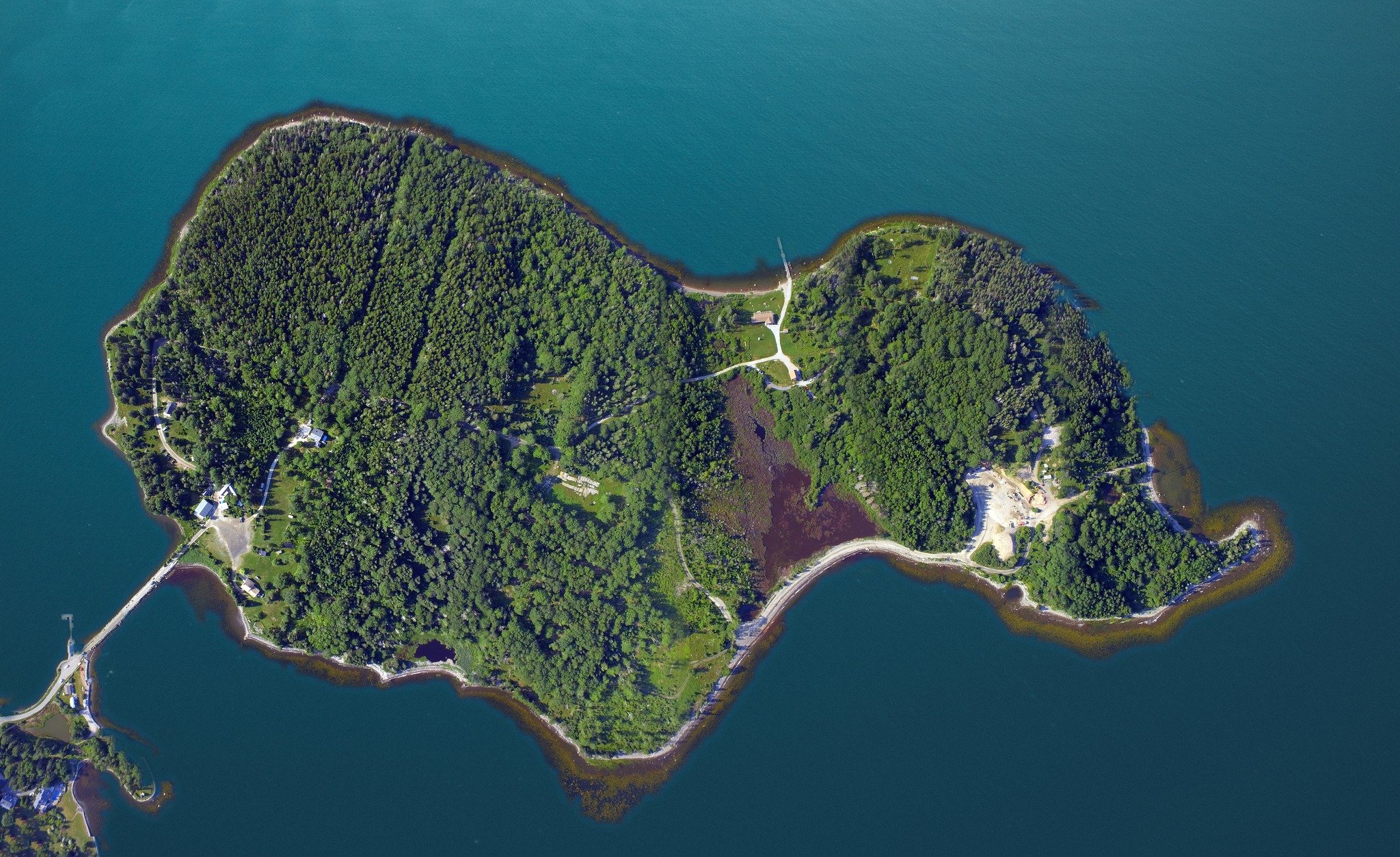
Tour Stop
1 McGinnis Foundation
This is the second home built by the McGinnis family, descendants of Daniel McGinnis, who discovered the depression that would later become known as the Money Pit in 1795. In 2007, the property was recognized as a Nova Scotia Registered Archaeological Site.
Tap a numbered marker on the map to explore each location.
- Stop 1: McGinnis Foundation — This is the second home built by the McGinnis family, descendants of Daniel McGinnis, who discovered the depression that would later become known as the Money Pit in 1795. In 2007, the property was recognized as a Nova Scotia Registered Archaeological Site.
- Stop 2: War Room — Built in 2016 as a set for The Curse of Oak Island, this is the room where Rick Lagina, Marty Lagina, and Craig Tester gather with the team each season to weigh new theories, review finds, and plan the next dig. On the wall hangs a copy of the January 1965 Reader's Digest article that first drew an 11-year-old Rick Lagina to the island.
- Stop 3: Hidden Wharf — Dan Blankenship was digging in the beach in 1972 when he uncovered a stone wharf that had sat under the tide for generations. Period shoes recovered at the site are now on display in the museum.
- Stop 4: Saw Mill / Centre Road — The road at your feet is Centre Road, laid out in 1762 by Surveyor General Charles Morris when he divided Oak Island into 32 four-acre lots — an arrangement still on the deeds today. The concrete posts to the left are what remains of Clarence Beamish's saw mill, which operated here from roughly 1930 to 1940, and the 1930s Goodwin Map relates to Lot 1, just beyond it.
- Stop 5: Lot 5 — Previously owned by Robert Young, Lot 5 became a Nova Scotia Registered Archaeological Site after work by Laird Niven and his team uncovered an unusual circular stone foundation and a range of early artifacts. The dating of these finds has raised questions about who was on the island, and when.
- Stop 6: Lot 25 (Samuel Ball Homestead) — Samuel Ball — a Black Loyalist who won his freedom fighting for the British in the American Revolution — purchased Lot 25 in 1785 and built his homestead here, eventually becoming one of the area's most established landowners. The site is a Nova Scotia Registered Archaeological Site, and the stone foundation of his home is still visible today.
- Stop 7: Lot 8 — The boulder in front of you weighs roughly 40,000 pounds, and it doesn't appear to have arrived here by accident — early investigation suggests it was deliberately placed and supported by smaller stones. Currently under archaeological investigation, the site is one of the most active areas of inquiry on the island right now.
- Stop 8: Nolan's Cross (Fred Nolan Property) — You're looking at Stone E, the base of Nolan's Cross — one of five massive cone-shaped granite boulders arranged in the shape of a cross measuring approximately 867 feet by 360 feet (264 m by 109.7 m). At the intersection point, Fred Nolan dug down three feet and found a flat greywacke boulder that appears to show the profile of a human face, deepening one of Oak Island's most debated mysteries.
- Stop 9: Drilling Area — This is where Rick Lagina, Marty Lagina, Craig Tester, and Dan Blankenship conducted their first joint drilling operation — the starting point of the modern, partnership-era treasure hunt.
- Stop 10: The Swamp — This large, slightly brackish body of water has produced some of the island's most intriguing finds, including manmade stone features still under investigation. Fred Nolan was among the first to argue that the swamp itself may not be natural — and ongoing work continues to test that theory.
- Stop 11: The Stone Triangle / Shore Pit — Captain Welling originally found the Stone Triangle here in 1897. It is an equilateral arrangement of stones with a semi-circular feature whose medial line pointed straight toward the Money Pit. Nearby is the shore pit that Robert Dunfield and Dan Blankenship dug in 1965–66 while searching for the legendary flood tunnels feeding seawater into the Money Pit.
- Stop 12: The Money Pit — This is where it all began. In 1795, Daniel McGinnis — then in his early 30s — spotted a strange depression beneath an old oak tree and returned with friends to start digging, and more than two centuries later, the Money Pit remains the most well-known treasure-hunting site in the world.
- Stop 13: 10X Shaft — Located using dowsing and dug by Dan Blankenship, his son Dave Blankenship, and Daniel Henskee, the 10X Shaft was excavated to a depth of 181 feet, with drilling continuing down to roughly 235 to 237 feet. Cameras lowered into the chamber at the bottom in the 1970s captured images the team has spent decades trying to explain.
- Stop 14: Cave-In Pit — In 1878, Sophia Sellers was plowing this field with a team of oxen when the ground suddenly gave way beneath them, revealing a deep, well-like shaft no one had known was there. Aligned between Smith's Cove and the Money Pit, it's widely believed to be a ventilation shaft for the island's legendary flood-tunnel system.
- Stop 15: Smith's Cove — First investigated in 1850, this cove is the site of an engineered offshore structure — including box drains that connect to a 520-foot flood tunnel running directly into the Money Pit. It's also the site of one of the hunt's most tragic days: in 1965, four members of the Restall team lost their lives in a shallow pit near the shore.
Before You Go
- Arrive 30 minutes before your scheduled tour
- Tours run rain or shine; the tram is covered
- Bring bug spray (essential), sunscreen, water, comfortable shoes, camera
- Dress in layers — coastal weather shifts quickly
- Photography welcome at designated stops
- Stay with your guide and on marked paths — Oak Island is an active research site
Accessibility
- The Money Pit Express is covered and wheelchair accessible
- Contact marketing@oakislandlegend.com in advance if you need mobility assistance
- All tours are guided — no self-guided access
After Your Tour
Oak Island Treasure Shop: 5 Oak Island Drive, Martin’s Point, NS — official merchandise and items crafted from Oak Island wood. A portion of proceeds supports Make-A-Wish Canada.
Salty Dog Sea Tours: See Oak Island from the water — a 90-minute narrated boat tour from the Oak Island Resort marina. Book at saltydogtours.com.
Policies
- Advance booking required — no walk-ups
- Refunds only if tour cancelled by us due to extreme weather
- Missed tours are treated as no-shows
- For corporate or group inquiries: marketing@oakislandlegend.com
Ready to Explore the Legend?
Tickets are limited each weekend — book your spot today.